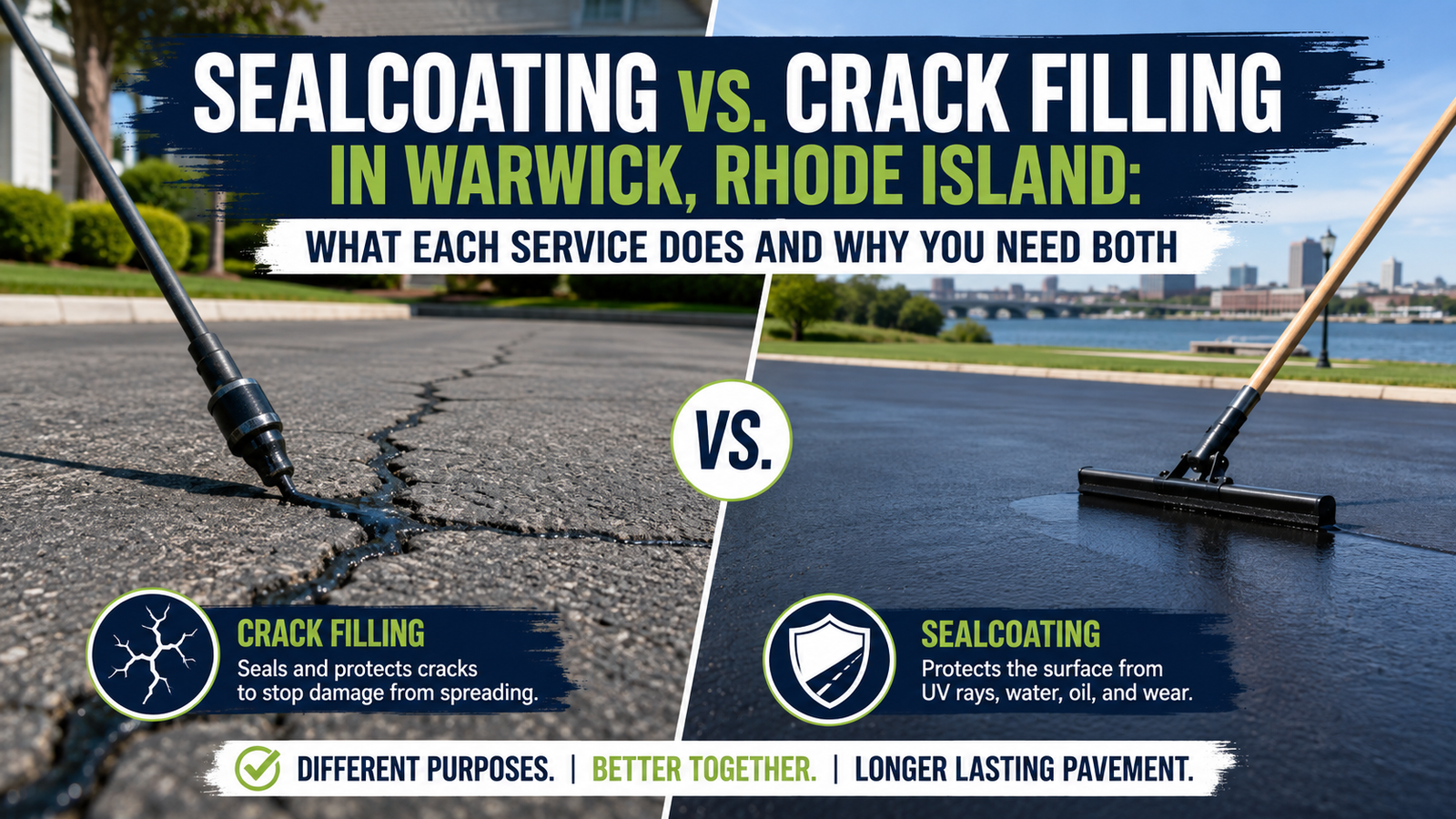
Sealcoating vs Crack Filling Warwick are the two most commonly recommended asphalt driveway maintenance services in Warwick, Rhode Island and they are also the two most commonly confused. Property owners sometimes treat them as interchangeable options, choosing one or the other based on price or what the contractor happens to offer, without understanding that they address fundamentally different problems and produce fundamentally different outcomes. This confusion is costly: choosing the wrong service, or applying the right service in the wrong order, produces maintenance that looks like protection without delivering it. This guide explains exactly what each service does, what problem it solves, and why both are almost always necessary not as alternatives to each other, but as complementary services performed in the correct sequence.
What Crack Filling Is and What Problem It Solves
Crack filling is the application of a flexible sealant material into existing cracks in an asphalt surface to close them against water infiltration. Crack filling is a repair service: it addresses damage that has already occurred. When asphalt develops cracks through thermal cycling, UV oxidation, base movement, or other mechanisms, those cracks become pathways for water to enter the pavement structure. In Warwick’s climate, water that enters through cracks during winter weather freezes, expands, and widens the crack with each freeze-thaw cycle. Crack filling interrupts this chain of events by eliminating the water entry pathway before winter cycling begins.
The material used for professional crack filling in Rhode Island hot-pour rubberized joint sealant is specifically formulated for the Northeast’s temperature range and freeze-thaw demands. Unlike the cold-pour crack fillers available at hardware stores, hot-pour material is applied at elevated temperature from a melting kettle, which allows it to fully penetrate the crack void and bond to the crack walls as it cools. The rubberized formulation provides critical flexibility the material expands and contracts with seasonal temperature changes while maintaining its bond to the surrounding asphalt. A crack sealed with hot-pour rubberized material before winter will maintain its seal through 30 to 50 Rhode Island freeze-thaw cycles far more reliably than one filled with cold-pour material from a cartridge.
What crack filling does not do is equally important to understand. Crack filling does not restore structural integrity to cracked asphalt. It does not fill the crack so completely that the pavement looks like new. It does not prevent the crack from slowly propagating further over time. What it does and this is its specific and critical value is prevent water from entering the crack and reaching the base. This single prevention is the most consequential maintenance action available for extending the life of a Warwick driveway, because water infiltration to the base is the enabling mechanism for freeze-thaw structural failure.
When Crack Filling Is Appropriate in Warwick
Crack filling is appropriate whenever cracks are present in an asphalt surface that is otherwise structurally sound. Longitudinal cracks (running parallel to the driveway’s length), transverse cracks (running perpendicular to the length), and isolated surface cracks from root pressure, edge loading, or surface oxidation are all candidates for crack filling as long as the surrounding pavement is structurally intact.
Crack filling is not appropriate as a substitute for deeper repair when the cracks indicate base failure. Alligator cracking the interconnected, polygon-shaped pattern that signals base failure requires structural repair, not crack filling. Filling alligator cracks treats the symptom while the underlying structural failure continues unaddressed, and the filled cracks will re-open and extend within one to two seasons because the base movement driving them has not been corrected.
The timing of crack filling is as important as its application. Warwick’s fall season September through October is the optimal window for crack sealing before winter. Filling cracks before the first freeze means the water entry pathways are closed before the freeze-thaw cycling that would exploit them begins. A crack left unfilled through a Warwick winter has been subjected to 30 to 50 potential ice-expansion events that each widen it slightly and push water deeper into the pavement structure.
What Sealcoating Is and What Problem It Solves
Sealcoating is the application of a liquid protective coating over the entire existing asphalt surface, forming a continuous protective film when cured. Sealcoating is a preventive maintenance service: it protects against future damage rather than repairing existing damage. This is the most fundamental distinction between the two services, and it is the one most frequently misunderstood. You cannot sealcoat a crack away, and you cannot crack-fill UV oxidation away. They address different problems.
UV protection is sealcoating’s most important function in Warwick’s climate. UV radiation from the sun progressively oxidizes the asphalt binder the petroleum-based material that holds aggregate together and gives asphalt its flexibility. As the binder oxidizes, the asphalt surface turns from black to gray, becomes brittle, and develops surface cracking from thermal stress. A sealcoat film absorbs and reflects UV radiation before it can reach the asphalt binder, dramatically slowing the oxidation process. A sealcoated Warwick driveway maintains binder flexibility and surface integrity significantly longer than an unsealed one exposed to the same UV loading over the same period.
Water resistance is sealcoating’s second major protective function. Asphalt has micro-surface voids tiny spaces between aggregate particles at the surface through which water can slowly infiltrate. A sealcoat fills these micro-voids and creates a relatively impermeable surface film that prevents minor surface water infiltration. This is distinct from what crack filling does: crack filling addresses discrete, visible cracks, while sealcoating addresses the diffuse micro-permeability of the overall surface between cracks. Both protections are needed simultaneously.
Chemical resistance from petroleum products is a third benefit. Gasoline, engine oil, and other petroleum-based fluids that drip or spill onto an unsealed asphalt surface can dissolve the asphalt binder, creating soft spots that deform under vehicle loads and eventually develop into structural failures. A sealcoated surface provides a chemical-resistant barrier that prevents this penetration. This protection is particularly relevant for Warwick homeowners who refuel vehicles in the driveway or park vehicles with known oil leaks.
Why Sealcoating Cannot Substitute for Crack Filling in Warwick
This is the most practically important insight about the sealcoating-versus-crack-filling question: when a Warwick homeowner applies sealcoating to a driveway with existing open cracks without first filling those cracks, the sealcoat coats the surface around the cracks but cannot adequately seal the crack openings themselves. The sealcoat film bridges over the cracks rather than penetrating them, and because sealcoat is a thin film rather than a deep-penetrating sealant, the bridge over each crack is fragile and breaks down quickly under temperature cycling.
The result is a driveway that looks newly maintained freshly black and uniform in appearance but is not actually protected at the crack locations where freeze-thaw infiltration will occur through the coming winter. The homeowner has invested in sealcoating and received the appearance benefit without the structural protection they needed most. Meanwhile, the unfilled cracks experience their first post-sealcoating winter with the same water infiltration exposure they had before except now the crack entry point is slightly obscured beneath a thin film that provides no real resistance.
Conversely, crack filling a severely oxidized, gray driveway without sealcoating the full surface addresses the immediate crack-related water infiltration risk but leaves the binder exposed to ongoing UV oxidation. The surface continues to gray and embrittle, new cracks develop at an accelerating rate, and the filled cracks are joined by new ones within one to two seasons. Crack filling is most durable and effective when the overall surface is protected by sealcoat.
The Correct Maintenance Sequence: Always Crack Fill First, Then Sealcoat
Understanding the distinction between the services immediately establishes the correct maintenance sequence: crack filling must always precede sealcoating, not follow it. The logic is straightforward and allows no exception. Crack filling requires that the crack be clean, dry, and accessible with full-width crack walls exposed for the hot-pour material to penetrate and bond to as it cools. Sealcoating applied first coats the crack edges with sealcoat material, reducing the surface area available for crack filler adhesion and introducing a contaminating layer that prevents the mechanical bond needed for the filler to perform correctly.
In practice, professional Warwick paving contractors who provide both services sequence them correctly as standard practice. The crew fills cracks on day one, allows a cure period of 24 to 48 hours for the hot-pour material to fully set, and then applies sealcoat over the entire surface. This sequence produces the most comprehensive and durable maintenance result: existing damage repaired and water entry pathways closed, then the entire surface protected against future UV damage and water infiltration.
How Often Each Service Is Needed in Warwick
Crack filling frequency is determined by the appearance of cracks rather than a fixed calendar interval. Inspect the driveway surface at least twice annually once in fall before winter and once in spring after winter for new or widened cracks. Anything that appears should be filled before the next winter season. Some well-maintained Warwick driveways with good subbase and drainage develop few new cracks between maintenance cycles; others in more challenging soil or drainage conditions may develop more between cycles. The inspection determines the need, and the need determines the frequency.
Sealcoating frequency for Warwick residential driveways is typically every three to five years. This interval allows the previous sealcoat to wear naturally without building up an excessive accumulated thickness that can itself crack and peel. Sealcoating more frequently than once every two years risks accumulation that creates adhesion and performance problems. Waiting longer than five years in Warwick’s UV and weather environment allows oxidation to progress to the point where the sealcoat has a degraded surface to protect and its full benefit is diminished. New driveways should wait at least 90 days ideally one full year before the first sealcoat application.
Common Questions About Sealcoating vs. Crack Filling in Warwick
Should I sealcoat or crack fill first? Always crack fill first, then sealcoat. Crack filling requires a clean, accessible crack surface for proper adhesion of the hot-pour material. Sealcoating first contaminates the crack edges and reduces filler adhesion at the most important maintenance location on the entire driveway. Allow the crack filler to cure for 24 to 48 hours, then sealcoat the full surface.
Can sealcoating seal small cracks? No. Sealcoating is a thin film product typically 1/16 to 1/8 inch thick when dry designed to coat the asphalt surface, not to fill crack voids. It will bridge over a crack without filling it, and the bridge breaks down quickly under temperature cycling. Even small cracks require dedicated hot-pour crack filler applied specifically to the crack void for durable protection.
How long does sealcoating last on a Warwick driveway? A professionally applied two-coat sealcoating application typically provides three to five years of effective protection on a residential Warwick driveway under normal traffic conditions. Higher-traffic areas, particularly the entry section where turning movements concentrate vehicle loading, may show wear earlier than the main field of the driveway. Touch-up of high-wear areas between full applications is possible with some sealcoat products.